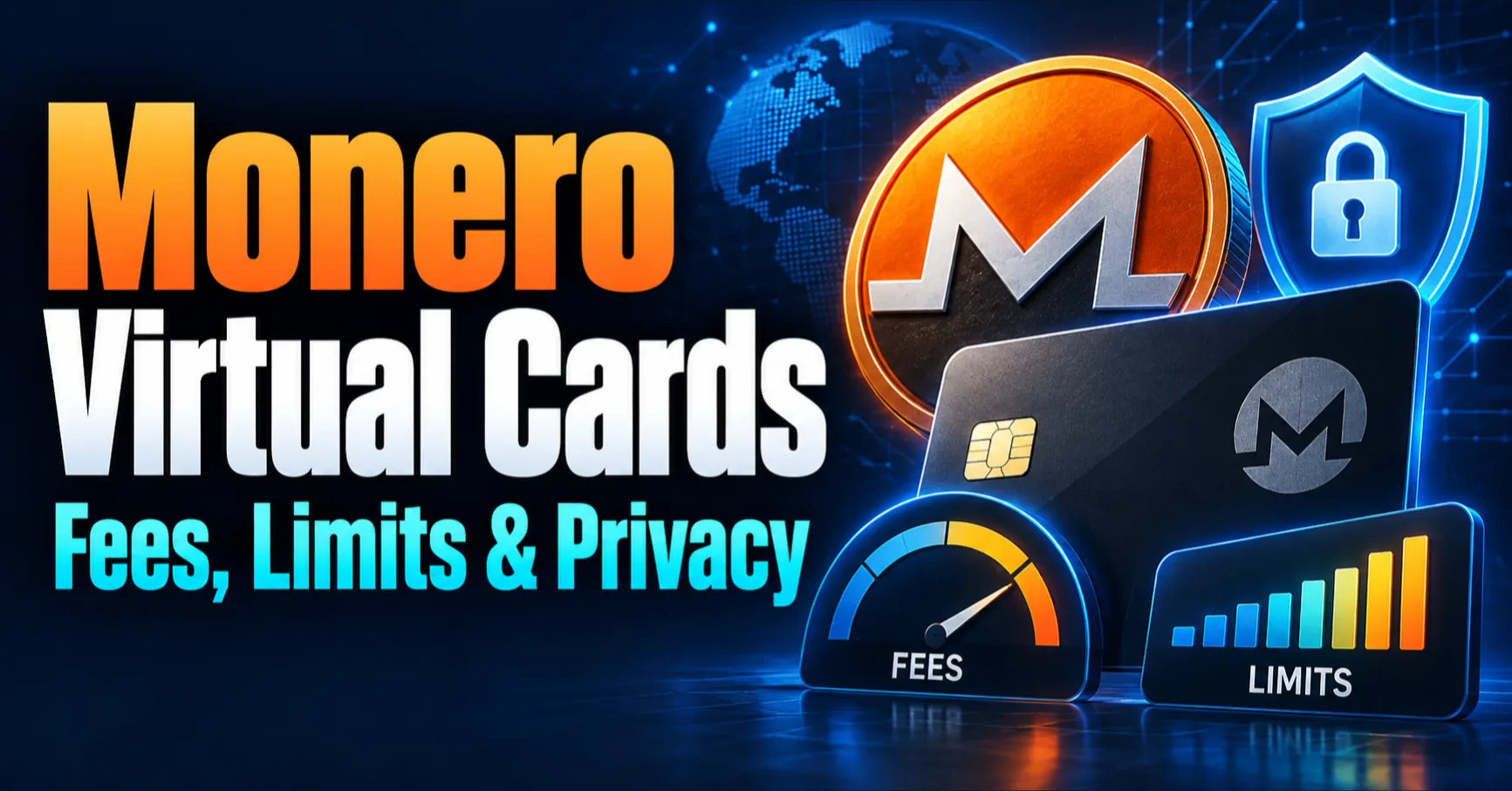
A Monero virtual card has several fees and several privacy boundaries. The XMR transfer, Cryptomus invoice, wallet credit, card funding and merchant purchase are separate events.
The complete fee stack
| Layer | Possible cost | Source of truth |
|---|---|---|
| Monero network | Sender fee | Your wallet before broadcast |
| Cryptomus | Live quote or conversion spread | The current invoice |
| Card creation | Issuance | Card selection screen |
| Card funding | Percentage or fixed top-up cost | Funding confirmation screen |
| Card lifecycle | Maintenance or replacement | Current fee schedule |
| Card usage | FX, transaction, decline or refund | Fee schedule and transaction record |
The official Monero guide explains that the sender pays the network fee and that it depends on congestion and transaction data size rather than only the transferred value.
Calculate the real cost
- Record the fiat value represented by the live XMR invoice.
- Compare it with the wallet balance credited after confirmation.
- Subtract card issuance and funding costs.
- Include maintenance for the period you will keep the card.
- Add likely FX or usage costs for the merchant purchase.
Use the current VelshoCards fee schedule. Old reviews with hard-coded prices can become inaccurate.
Limits to check before sending XMR
- Cryptomus deposit minimum and maximum
- Account and wallet credit controls
- Card eligibility and quantity limits
- Card funding minimums, maximums and frequency
- Per-transaction and merchant-category restrictions
- Country and billing-region rules
Privacy by payment layer
| Layer | Privacy characteristic | Limitation |
|---|---|---|
| Monero blockchain | Public observers do not see sender, recipient and amount like a transparent chain | Services involved still process the payment |
| Cryptomus invoice | Receives the XMR deposit | The invoice is tied to a platform order |
| Platform and issuer | Operate the wallet and card | Card activity is not a Monero transaction |
| Merchant | Processes checkout | Accounts, devices and shipping create separate records |
Reduce avoidable costs
- Plan funding instead of making many tiny deposits and top-ups.
- Keep an authorization buffer to avoid insufficient-balance declines.
- Use one card for compatible trusted subscriptions when fixed per-card costs matter.
- Use separate cards when isolation is worth the additional cost.
- Investigate one decline before retrying.
Compare card-selection criteria in Best Virtual Cards for Monero, or use the step-by-step XMR card guide when you are ready to fund.
Frequently asked questions
What fees apply to a Monero virtual card?
Costs can include the XMR network fee, Cryptomus quote, card issuance, funding, maintenance, FX, transaction, decline, refund or withdrawal charges.
Are Monero fees based on the amount sent?
Not directly. Monero fees depend on network conditions and transaction data size rather than simply being a percentage of the XMR amount.
Are XMR-funded cards private?
The XMR transfer has Monero on-chain privacy. The processor, platform, issuer, network and merchant still handle information needed for the deposit and purchase.
Which limits should I check?
Check deposit, issue, funding, transaction and balance limits plus merchant-category, country and frequency restrictions.
Why can a small purchase be expensive?
Fixed issuance, funding or maintenance charges consume a larger share of a small purchase. Compare final spendable balance rather than one fee.
Review the live numbers
Compare the current card fees, then open an account to view the XMR quote and limits.