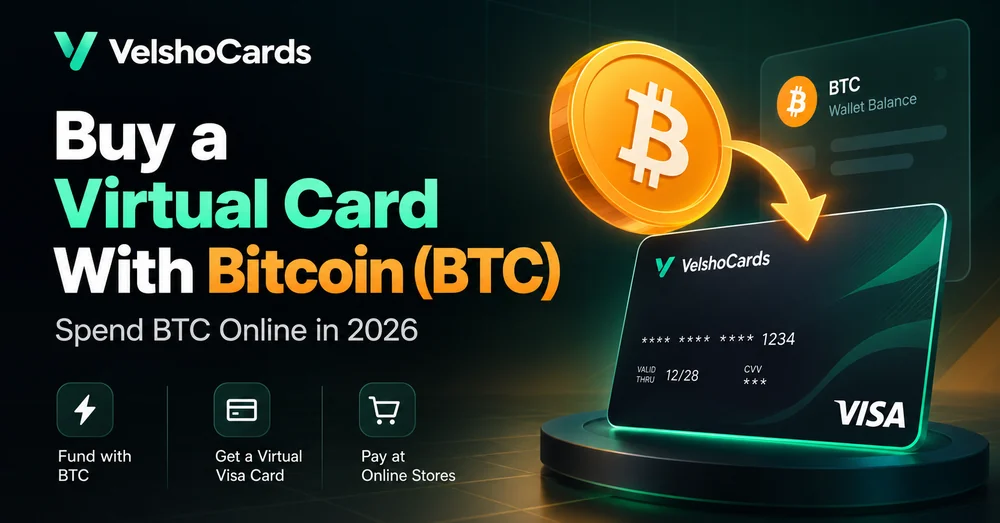
Short answer: if you hold Bitcoin but the website you want to pay does not accept BTC directly, you can deposit BTC into your VelshoCards wallet, issue a virtual card, fund the card, and use it at supported online merchants.
The merchant receives a normal card payment, so it does not need to support Bitcoin at checkout. The practical flow is simple: BTC → VelshoCards wallet → virtual card → online merchant.
Create your VelshoCards account to start with a BTC-funded virtual card.
What is a Bitcoin virtual card?
A Bitcoin virtual card is a digital payment card funded from value you deposit using BTC. Once issued, you receive the card details normally required at online checkout, including the card number, expiration date, CVV, billing information, and 3D Secure support where required.
You are not sending an on-chain Bitcoin transaction directly to the merchant each time you buy something. Bitcoin is used on the funding side, while the merchant processes the purchase as a conventional card transaction.
How to buy a virtual card with Bitcoin
- Create your VelshoCards account. Register here and open the dashboard.
- Choose Bitcoin as your deposit method. Open the wallet funding section and select BTC.
- Verify the deposit details. Confirm the selected asset, network, amount, and destination address before sending.
- Send BTC from your wallet or exchange. Wait until the required confirmations are complete and the balance is credited.
- Issue a virtual card. Open the Cards section and select the available card that matches your intended use.
- Fund the card. Move enough balance to the card for the purchase plus a reasonable authorization buffer.
- Pay online. Enter the card number, expiry date, CVV, and billing information shown for the card.
- Complete 3D Secure if requested. Finish any verification step before the checkout window expires.
Bitcoin transactions are generally irreversible after confirmation, so always verify the wallet address and network before sending.
How much BTC should you deposit?
Do not calculate from the advertised purchase price alone. Your available balance may also need to cover card issuance, card funding fees, merchant authorization holds, and possible currency conversion.
If you plan to make a $100 purchase, depositing BTC worth exactly $100 may leave too little spendable balance after fees. Check the live confirmation screen and calculate from the amount you ultimately want available on the card.
Where can you spend BTC through a virtual card?
A BTC-funded virtual card is most useful when a website accepts card payments but does not accept cryptocurrency directly. Typical supported use cases can include:
- AI and software subscriptions
- SaaS and developer tools
- Hosting and cloud services
- Digital products and licenses
- Online shopping
- Business tools and eligible advertising services
- Recurring subscriptions
Merchant approval is never guaranteed. Merchant category restrictions, regional controls, issuer rules, payment processor checks, recurring-payment settings, balance, and 3D Secure requirements can all affect authorization.
Why use Bitcoin instead of cashing out to a bank?
The traditional path can involve several steps:
BTC → exchange → sell BTC → withdraw fiat → bank account → debit or credit card → merchant
With a crypto-funded virtual card, the route is shorter:
BTC → VelshoCards wallet → virtual card → merchant
This can be useful when you already hold BTC and only want to turn part of it into online spending power without using your primary bank card at every merchant.
Bitcoin vs USDT for virtual card funding
BTC is convenient if you already hold Bitcoin
If your funds are already in BTC, depositing Bitcoin directly avoids an extra conversion step elsewhere solely to fund the card.
USDT can be easier for exact budgeting
Bitcoin's fiat value changes continuously. If you know you need a specific dollar amount for an upcoming payment, a dollar-pegged stablecoin can make budgeting more predictable.
Use BTC when you want to spend Bitcoin you already own. Use a stablecoin when maintaining a predictable fiat value matters more.
Why can a BTC-funded virtual card be declined?
Insufficient available balance
A merchant may place a temporary authorization hold or the final amount may change after currency conversion. Keep a small buffer instead of loading the exact checkout subtotal.
Incorrect billing information
Use the billing details associated with the virtual card rather than guessing or automatically entering a different address.
Unsupported merchant category
A transaction can fail even with enough balance if the merchant falls outside the card's supported merchant categories.
3D Secure was not completed
Some merchants require additional authentication. If a 3D Secure challenge appears, complete it before the verification window expires.
Repeated failed attempts
Do not keep retrying the same declined payment without identifying the cause. Repeated attempts can trigger additional merchant or processor restrictions.
Is a Bitcoin virtual card anonymous?
No. Crypto funding and complete anonymity are not the same thing.
Bitcoin operates on a public blockchain, and different parties involved in a card transaction can process different pieces of information. Merchants, processors, card networks, issuers, crypto payment providers, and blockchain analytics systems may each have access to transaction-related data.
A privacy-focused virtual card should therefore be viewed as a way to reduce unnecessary exposure of your primary banking details, not as a promise of complete anonymity.
Using one BTC-funded card for subscriptions
If you pay for several recurring services, maintaining one reusable card can be simpler than constantly issuing replacement cards. Keep enough balance available before renewal dates because a successful first payment does not guarantee a later recurring charge will clear if the card is empty.
You may still prefer separate cards when isolation matters more than minimizing card costs—for example, one card for subscriptions and another for one-off online purchases.
Frequently asked questions
Can I buy a virtual card with Bitcoin?
Yes. Deposit BTC through the available crypto funding flow, wait for the balance to be credited, then use that balance to issue and fund a supported virtual card.
Can I spend Bitcoin directly with the virtual card?
Bitcoin is used on the funding side. The merchant receives a normal card transaction rather than an on-chain BTC payment from you.
Do I need a bank account?
A traditional bank account is not required simply to deposit supported cryptocurrency into your VelshoCards wallet.
Can I use BTC to pay for subscriptions?
Yes, for supported subscription merchants. Fund the wallet with BTC, load the virtual card, and keep enough card balance available for future recurring charges.
Should I use Bitcoin or USDT?
BTC is convenient when you already hold Bitcoin and want to spend it. USDT can be easier when you need to maintain a predictable dollar value for a planned purchase.
How long does a Bitcoin deposit take?
Timing depends on Bitcoin network conditions and the payment processor's confirmation requirements. Track the transaction status rather than relying on a fixed estimate.
What happens if the merchant refunds my purchase?
Card refunds follow the merchant and card-processing flow rather than reversing the original Bitcoin transaction. Keep the card active until any expected refund is complete.
Turn your Bitcoin into online spending power
Holding BTC is easy. Using it at a website that only accepts traditional card payments is where the friction begins.
A Bitcoin-funded virtual card bridges that gap. Deposit BTC, issue a virtual card, load only the amount you need, and use it for supported online payments without relying on your primary bank card.
Create your VelshoCards account and get started with Bitcoin.